






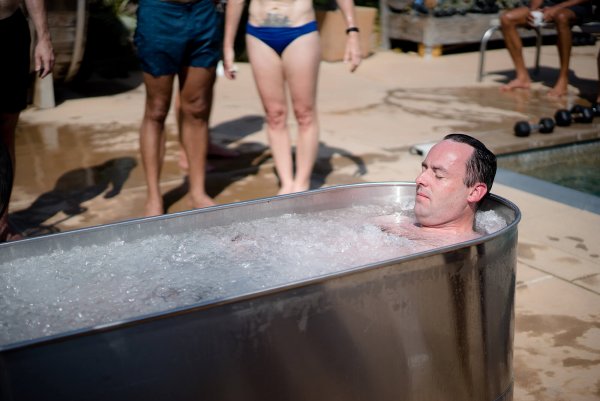
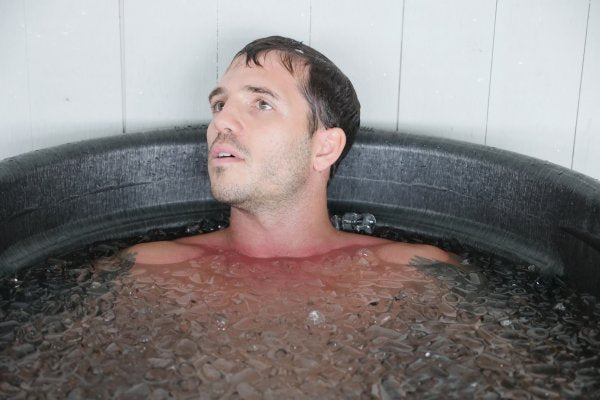
Thu May 09 2019 Recently, weve written extensively about the physiological advantages that contrast therapy providessuch as stimulating a shift from a sympathetic to parasympathetic state, boosting blood flow, and speeding muscle recovery. Yet, while these are significant, theyre not the end-all, be-all of high-heat and extreme cold exposure health benefits. To do the topic justice, we also need to consider the extensive psychological benefits. Shrink the Change If youve used the ice bath before, can you think back to the first time you got into it? If youre anything like me, you can probably vividly recall that extreme cold sensation and the feeling of strong aversion it triggered. Or, if you havent tried getting in the ice yet, perhaps you can picture how you think youll react when you do. Often, part of the problem is that someone has given you a certain time prescription, or you have your own notion of how long youd like to be able to withstand the cold. Say its two or three minutes. That sounds pretty obtainable, right? Until you actually get in and that cold blast hits you like a Siberian wind and you immediately start finding excuses to hop out. If youre going to reach your goal and avoid giving into the impulse to quit, you need to have a coping strategy. In their book Switch , Chip and Dan Heath advise overcoming a seemingly insurmountable challenge by shrinking the change. I was recently privileged to see a talk given by Robert ONeill, the member of SEAL Team Six credited with shooting Osama bin Laden. Among the many notes I made from his memorable stories, one stands out for our purposes here. When he was in BUD/S training, this meant not becoming overwhelmed by the months of demanding tasks that lay ahead. Rather, ONeill made it through by breaking each day down into small, manageable segments. Going into an early morning session, hed think, Just make it to breakfast, and then Just make it through PT, and so on. He knew that if he fixated on the entire 24 weeks, it would swallow him whole. By shrinking the change, he was able to break down the process into smaller, achievable tasks, a technique from psychology known as psychological chunking. This is similar to the technique of breaking a big aim into SMART (Specific, Measurable, Achievable, Relevant, Time-bound) sub-goals . At XPT Experiences , we apply our own version of shrinking the change to help people handle their initial response to the ice bath. If they give into their impulse to get out, it will set a precedent for failure. Instead, we want to empower people to experience a series of small successes that will encourage them to keep practicing contrast therapy once they leave. To do so, we need to get them to stop over-emotional and irrational thinking that can easily take hold during taxing situations, and encourage a transition to the kind of System 2, rational thought that Daniel Kahneman explores in his book Thinking, Fast and Slow . To do so, we shrink the change by urging them to forget time goals, and instead focus on achieving three slow, controlled, nasal breaths. Once theyve done this (and 99 percent find they can), we might advise them to take two more breaths, then two more. By the time they finish this descending sequence and gain control of the breath, theyve probably spent long enough in the tub to have spurred physical adaptation, and on the mental side, theyll now know that they can ride out the impulsive response to leap out immediately! Plus, theyll have had another opportunity to use breath to control their state. Now, theyre equipped with multiple tools to go away and either continue taking ice baths, or to apply to any stressful and emotionally-fueled situation. Cultivating Community Another coping mechanism used during contrast therapyand extrapolated to everyday challengesis teamwork. At XPT, one of our main principles is fostering community. Sometimes this involves simply doing fun things together like going out on the water for a SUP paddle or sharing a meal. But at other times, its good to come together to do hard things with like-minded individuals. In doing so, everyone will push each other to go further than they could alone. We know from scientific literature that group challengeswhether its recruits braving Navy SEALs Hell Week or XPT Experience attendees encouraging each other during sauna sessions and ice bathsdoesnt just increase camaraderie, it also prompts neurochemical changes in the brain. A paper published in Frontiers in Human Neuroscience found that group singing increased the release of oxytocin, which is sometimes referred to as the cuddle hormone. Another Baylor University study concluded that couples who played board games or took painting classes together released more oxytocin. The same is true of engaging in more rigorous challenges with a group. Quite often at XPT Experiences, first-timers want to immediately jump out of the ice bath and struggle through their first exposure. Back in the sauna they bond over this challenge, gain courage from others success, and come back to brave the cold again. Most people tremendously outperform their previously imagined capabilities. The combination of multiple rounds, followed by close quarters sauna discussions afterwards, forges a unique bond and team mentality. Coming Back to the Present Moment The same is true of the sauna. A Get me out of here response isnt typically as rapid as it is in the ice bath because the heat feels nice at first, rather than shocking your system. But even when youve been using the sauna several times a week, you can still run up against the temptation to check out early. I experienced this first-hand recently. I was with a friend whos a UFC fighter and our plan was to do two, 20-minute stints in the sauna at 230 degrees Fahrenheit. We didnt have access to an ice bath, so we planned to sandwich the sauna time around a few minutes under the head of a cold shower. I felt fine until about the 12-minute mark in the second session, when I noticed we were both bent over with our hands on our knees. At 15 minutes, I began feeling claustrophobic and had to stop talking. And by 17 minutes, I started panicking and questioning whether I could hold out until the end of the session. Even a few minutes can seem like an eternity when the heat starts to get to you like this! What did I do? Instead of quite literally throwing in the towel and getting out, I returned to my breath to bring my focus back to the present moment and stop my minds negative cascade. I said to myself, Just take two more breaths. Then when Id done that, I said, OK, one more breath. Looking up at the clock, I saw we were at 19 minutes and 40 seconds, and knew I could hold out for the final 20 seconds. And I was glad I did. The Power of Affirmations and Mantras Breathing is just one of the tools that can come in handy when youre struggling to stay in the ice bath or finish off a spell in the sauna. Another technique that has proven its worth for thousands of people who have joined us at XPT workshops and Experiences is using mantras and affirmations. Our co-founder Laird Hamiltons favorite thing to say to himself is, This is my house. This is where I live. Many others have since adopted this simple, but highly effective phrase as their own. Personally, I like telling myself, Im calm and in control. If I need something else to keep me going in a tough situation, I might use affirmations to make me feel invincible or like a warrior. One of the Brazilian Jiu-Jitsu world champions I train frequently reminds himself that hes a man of honor and integrity. Theres no one-size-fits-all prescription when it comes to developing our own mantra or affirmation, but you can start by thinking of a phrase that fits an important aspect of your identity and encourages you to be positive. Then, play around with the wording and try out as many alternatives as you need to find something that resets your mental attitude and helps you push through anything. Once youve got it down, dont just use it in the ice bath or sauna, but anytime throughout the day that you need to reenergize or encourage yourself. Go Forth and Conquer In the course of the past few hundred words, Ive given you four coping mechanisms you can take away and apply to the ice bath and sauna, and also to the challenges we all face in work, sports, and life: Shrink the change Shrink the change Teamwork/community Teamwork/community Come back to the present Come back to the present Mantras and affirmations Mantras and affirmations At face value, ice baths and saunas appear to be purely physical challenges. But if youre willing to dig a little deeper, youll see that theyre actually rich experiences that can make you a more capable, resilient, growth-minded human. In the end, thats what XPT is all about.

Leave a comment
This site is protected by hCaptcha and the hCaptcha Privacy Policy and Terms of Service apply.