





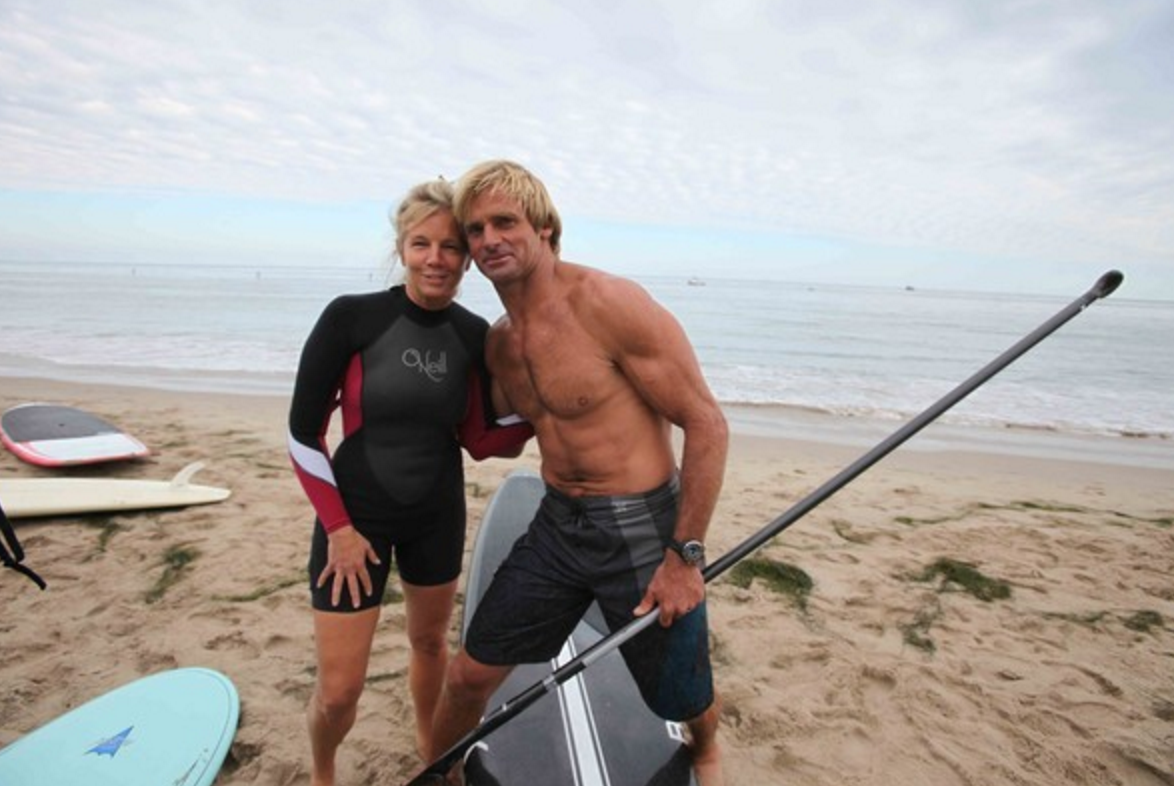
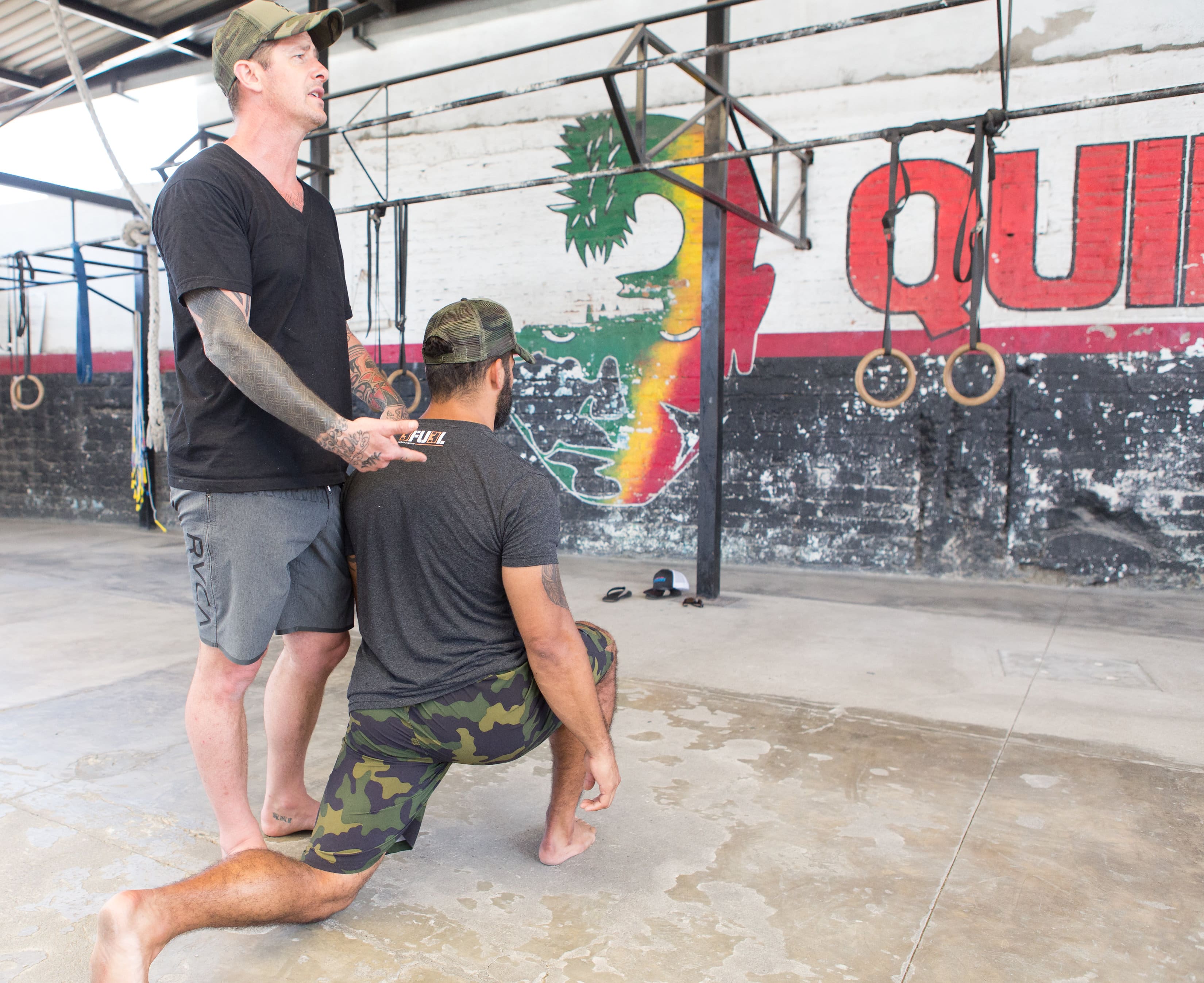
Tue May 16 2017 There are two basic things to know about Jeff Sweet. One, he tells great stories, so be prepared to laugh. A lot. And two, the man does more in one day than most of us do in a month. As an early pioneer of stand-up paddle boarding with Laird, Jeff is a legend in the field. We spoke with him while he was driving down PCH to give a surf lesson. XPT: Whats a typical day in the life of Jeff Sweet like? JS: Its impossible to tell you what a day in the life of Jeff Sweet is like. Impossible. You dont have time! XPT: Go aheadwere all ears! Give us a little glimpse. JS: Well, I have a day job. Ive been a Deputy Sheriff for Los Angeles County for twenty-seven years. Typically, Ill be at work at 5:30 a.m. in the morning and then head to the beach after work and give lessons. Some days it can be three or four lessons. Paddle surfing as well as distance paddling. Then, I run to one of my three childrens water polo games that I dont miss. I just fit it all in. Lets take this past Saturday to Sunday, for example. Saturday started with a surf lesson for a family in Ventura. From Ventura, I shot back down to Malibu for three surf lessons in the afternoon. Sunday I worked a private celebrity party until 1:30 p.m. then I flew down to Cardiff to meet Chuck Glenn where I returned from my four-year hiatus from foil boarding. XPT: Why was there a hiatus? JS: Because Laird broke my leg in thirteen placesand you can print that! It was all his fault. But thats a story for another time. XPT: Were not letting you off the hook so easily on that one. Well come back to it. But lets start from the beginning. How did you and Laird first meet? JS: I met Gabby first. I was working for Kobe Bryant and Gabby attended an event and brought Laird. Their friend Nancy also showed up with a surfboard in the back of her truck. I just took it upon myself to walk out there and take her board and put it away. Otherwise, that board wouldve disappeared. And because of that, Laird and I had a conversation and he invited me to go for a surf the next day, and the rest is history. This was about 1998 or 1999. Don Wildman, Jake Chelios, Chris Chelios, Laird Hamilton, Jeff Sweet, Nate Heydari circa 1999 XPT: How did surfing together evolve into paddling? When did that first come into the picture? Laird and I surfed together for a while. He had a big tandem board made by his dad, Billy Hamilton. We took an old kayak paddle, cut the end off of it, put a t-handle on it and taped it all together. I actually still have that paddle. I think its probably the first stand-up paddle that was ever made. We made it right there on the beach at Don Wildmans place. So, Laird would paddle up to Little Dune (in Malibu) and I would paddle on my stomach. Its a long paddle to the Point. We made another paddle and I started paddling over with him. At first it was just who could make it to the Pier without falling off. It only took a few shots until we could actually make it. We were paddling these giant twelve-foot, big, heavy boards at the time. Gerry Lopez turned Laird on to Ron House, who shaped our first boards down in San Clemente. So, I drove down to San Clemente and picked up the very first batch of stand-up paddleboards. All twelve feet. Six of them stacked in the back of my truck, all with a Gerry Lopez logo. For about five years, it was pretty much just Laird, myself, and Sam George out at the Point stand up paddling. Nobody else was paddling. For the longest time it was just our group of friends. Nate Heydari and Todd Thompson. And (NHL hall of famer) Chris Chelios, too. To this day, Chris has evolved into a surfer. He still surfs the same as he did ten or twelve years ago. I love surfing with Chris. He totally cracks me up. Hes the most stoked Hall of Fame professional athlete on the planet to surf. Theres nobody else who surfs like this guy. Nobody. XPT: So, thats how it all started? JS: Thats it. The beginning of stand-up paddling. Then, gradually, we would go places with Ron House, like San Onofre, and thered be maybe one other guy stand up paddling. XPT: How did it evolve from there? JS: Slowly. Wed be out there every day at Don Wildmans and then on the weekends other friends would show up and theyd try to paddle. It was really born right there at the beach at Wildmans place. In the beginning, we kept breaking paddles. Of course, nobody was making a stand-up specific paddle then. It took years of trial and error to develop them. XPT: We saw that Laird gave you a nice shout out in Stand-Up Paddle magazine last month JS: I was honored to be mentioned in the last sentence of a four-page interview! Thats the props I get for the shit that I do. (laughs) XPT: So, when people go to an XPT Experience the team thats there is incredible. Tell me about that. JS: Yeah, its an insane group. Theres so much talent in the team that I assemble for XPT. People are paddling all over the world and unfortunately, we see them with sub-par instruction. If youre going to come to an XPT Experience you should have the very best instruction. All the guys that we bring are at the very top of the sport. Gene Smith has been paddling since the beginning, he even opened his own shop down in Redondo Beach. Hes such a great ambassador for the sport. Obviously, Chuck Glenn, who is one of the top paddlers in the world. I call him Inspector Gadget. That guy can fix anything. At the XPT Experience in Punta Mita, Mexico, Fernando Stalha, who is also a top world-class paddler, took the lead. Im stoked for him to be involved. Hes a great asset. Chuck Glenn, Steve Crane, Gene Smith & Jeff Sweet ready XPT Experience participants for the SUP session Most people who come to XPT have never paddled. Paddling is only a part of the whole XPT Experience but I think its the most fun part. People come from all over the world and some of them are afraid of the ocean. We get them comfortable and get them past their fears. I was out the other day with a student of mine, and two grey whales passed within five feet. She said it was the most amazing experience of her lifetime. To me, thats pretty cool. Ive had people paddling with me when weve been surrounded by a pod of dolphins. One of the women just sat down on her board and started crying. Shed never seen anything like it. Another student had tried to surf for a couple of years. Traditional lay down, prone surfingbut it just wasnt clicking. He came to me and said, Surfing isnt working I want to try stand up paddling. I see guys catching waves and I really want to try. Immediately, hes catching waves. Immediately. And hes hooked. Now he is a surfer! This is a guy who has spent most his life at country clubs playing golf and never really stepped out into action sports, and he travels with me every year to Fiji to paddle surf. He sent me an email and he said in the last line, Youve changed my life. To me, thats enough. Im not setting out to do that, but if that happens its pretty cool. XPT: While were talking Hawaii, talk to us about that time you biked and paddled across the entire state? How do you get ready for something like that in terms of training? JS: If you ask Laird, hed say you dont get ready for something like that. Id say shouldnt we go on a bike ride? And he says were going to bike plenty on that ride, so no. But he forgets that not everybodys super human like he is, so Id go and bike secretly on the side. We did the Paddle and Pedal Across Hawaii in 2007 to raise money for our friend Don King and his documentary, A Beautiful Son , about autism awareness. We started on the south end of the Big Island and we pedaled 116 miles and then paddled from the Big Island to Maui across the Alenuihaha Channel, its one of the most dangerous in the world, for forty-three miles. From there, we biked across Maui to the North side, which is about fifty-miles and then paddled to Molokai. Thats about eleven miles. Then, we pedaled Molokai (30 miles). Jeff & Laird heading out in Malibu, CA XPT: In one day? JS: In one day. Paddling across to Molokai was the only paddle-leg during the whole trip when the wind did help us. Don Shear was filming us from a helicopter. A mile out, Laird makes a right-hand turn and then I lost him. He just disappeared. I see Dave Kalama who was paddling with us. So, I just kept paddling and our friend Brett Lickle jet ski-ed out and told me that Laird had to go film something and that I should keep paddling straight across. So, there I was paddling completely by myself. This fishing boat comes along with these three big Hawaiians. They stopped and ask if I was okay and if I needed anything. I said I was fine and then they handed me a McDonalds cheeseburger and left. Laird is a masochist. Im telling you, Laird is not human. About dusk he finally arrives on Molokai and I thought we were done for the day but he wanted to keep going. In that one day, we pedaled the Big Island, paddled to Maui, peddled across Maui, paddled to Molokai and then pedaled across Molokai. It was nuts. XPT: How many miles is that? JS: Too many. We arrived at our meeting point at about ten oclock at night and were starving. So, so hungry. Have you ever eaten around Laird? Food is like an Olympic sport to him. We can all put it away but he can eat mounds. So, we get to the end of our ride on Molokai and theres nothing to eat. No food. They werent expecting us until the next morning. So, I take one of the cars from the team and go looking for something to eat. If you have ever been to Molokai then you know that theres a lot of nothing and what is there is closed. But I finally come across this mom and pop Italian place. There are fifteen of us: Laird, myself, the rest of the guys and the film crew. I need food to go for fifteen people. The guy looks at me and with a totally straight face, tells me he only has enough for four people. I couldnt believe it. He had no more food. By the time the night was over I think I had a meatball and three strands of spaghetti. I swear. The next morning, we went to a hotel for a huge breakfast. Someone brought us all of these breakfast burritos to put on the boat for the paddle across to Oahu, which is thirty-two miles. Everybody heads out. We take off, paddled away and somebody left all the food on the beach. Another food disaster. So, we get to Oahu and we spend the night. The next morning, we head out to Kaena Point pedaling from Sandy Beach 50-something miles across and were ahead of schedule. So, we need to wait a whole day for the full moon. When we get to dinner, Laird is quiet. I see the wheels turning in his head. I know something is coming. Everyone is eating tons of food, steak, everything and one of the guys asks when well be leaving the next day. Laird looks up and says, Were leaving now. Lets go. And before I know it, its 10 p.m. and were paddling out of the harbor into a fifteen-foot open ocean swell. Thats Laird. We paddled into the wind and in the rain to Kauai. We arrived there as it was getting dark the next day. It took twenty-two hours to paddle from Oahu to Kauai. The next morning we pedaled to the Kilauea lighthouse and we were done. That was it. XPT: And you guys did the Race Across America sometime after that? JS: Yes. In 2009. I was the chief of a crew of four guys. Laird didnt think biking across America was enough and he wanted to add a paddling leg. We paddled from Don Wildmans house in Malibu all the way to Oceanside (120 miles). We left at 8 a.m. and arrived in Oceanside harbor about four in the morning. We started with ten guys. By about midnight there were four of us leftLaird, myself, Chuck Glenn and Gene Smith. Then we started the Ride Across America. Sadly, we only made it to Herman, Missouri. One of our riders got run over by a support vehicle. Jason Wynn. Its a small town. You couldnt get into a traffic accident if you tried. Laird and I were riding in our support vehicle and another team pulled around us and hit Jason. The good thing that came from that story is that Laird and Gabbys nanny Jess felt badly for Jason, and while he was recuperating, he fell for her and now theyre married with three kids! XPT: Whats your regular training like? JS: I circuit train. I mountain bike. Unfortunately, in the last four years Ive broken my leg twice. Once on Kauai with Laird. XPT: Okay, lets hear it. Tell us how Laird broke your leg. JS: We went out to foil surf. I had been foiling for about ten years so Im pretty experienced. But the board wasnt set up for me. It was nobodys fault but mine. I had a bad fall and broke my leg in thirteen places. The guys take me back to Lairds dock and Im sitting there on the dock with four guys looking at me wondering if they should take the boot off (you use a snowboarding boot for foiling). I guess I was in shock because the pain hadnt really kicked in yet. Laird immediately switches gears. Hes great in an emergency situation. With what we do, we have to be. You never know whats going to happen. Hes thinking miles and miles down the road. He says, take the boot off and we have to get you into dry clothes because youre going to be sitting in the hospital in wet clothes. They take my clothes off and Im lying there naked and then they put on a pair of shorts and t-shirt. Even being in shock, it was still funny as hell. But I lost my favorite board shorts that day. Never saw them again. They put me in Lairds truck and off we go. Then the pain kicked in. And its bad. Im in a lot of pain. I have no control of my leg. Every time Laird hits the breaks my leg falls to the other side. Were in front of the hospital and instead of turning into the hospital; he turns in the opposite direction. And Im yelling, WHERE ARE YOU GOING, WERE HERE?!? And he says he wants to get some food for me because well be in the emergency room for a while and theres no food. We finally get to the hospital and Im being wheeled in with my plate lunch on my lap. They x-ray my leg. The emergency room doctor comes in and looks at the x-ray. He cant even tell what hes looking at. Thats how bad it was. Laird spent the rest of the afternoon with me in the hospital. XPT: Youre a busy dude. Before we let you go, talk to us a little about XPT and some of the success stories that resonate with you. JS: I love being part of peoples success stories. I love seeing people get out of their comfort zone and being vulnerable to change, and that happens at an Experience. Most people have their gym routine or their cycling routine or whatever their routine may be. They come to XPT and theyre getting into the pool and theyre not always comfortable with that. Theyre doing exercises underwater that they are really not comfortable with and then they are getting in the ice tubits just a whole other realm for most people. When its over, they cant believe all that theyve accomplished. Like Chris and Paula Murphy. They are awesome. They are such cool people. They moved out here from Chicago and they cycled, did Pilates and yogabut because of XPT, theyve become surfers. I mean, real surfers. I see them out there at least three times a week. XPT exposed them to things they never really considered. They are textbook people that went through the XPT Experience and it really changed parts of their lives. Now their kids are surfing, too. And then theres (Director/TV Producer) Gary Fleder, who told me how much he loved XPT. He said, Im in the ice tub, I go under and then come up and theres Laird Hamilton. I mean, hes right there! Right in front of me, coaching me. It was so inspiring! And thats it for me. Breaking people out of their routines and getting them out of their comfort zones. You never know where it might lead. Want to paddle with the legendary Jeff Sweet? Come and get out of your own comfort zone. Join us for a transformative journey at the XPT Experience. For the full list of upcoming Experiences click here .

Leave a comment
This site is protected by hCaptcha and the hCaptcha Privacy Policy and Terms of Service apply.